
A hospital communication system is the facility-level layer of synchronized clocks, operating room timers, overhead paging speakers, digital message boards, and silent duress switches that keeps every department and every chart on the same second. Without one, medication logs, lab results, and code documentation carry timestamps that disagree with each other, and every disagreement is a legal and billing exposure. We have built these systems since 2008 from Culver City, California. Twelve of the 72 organizations on our customer wall are hospitals and health systems, from Cedars-Sinai and Memorial Sloan-Kettering to the University of Colorado Hospital. The KRONOsync® transmitter we ship today broadcasts on a licensed 467 MHz radio frequency chosen because it does not interfere with the frequencies already in use across the medical industry. This page explains how the whole system works in healthcare facilities, what each part does, and where building infrastructure ends and clinical software begins.
In Short
- One synchronized signal runs the hospital clocks, surgical timers, overhead paging, digital signage, and silent staff duress alerts for an entire facility and scales across a multi-building campus or health system.
- Three clock technologies (467 MHz wireless, Power over Ethernet, and Wi-Fi) sync to one GPS or NTP time source, adjust for daylight saving time automatically, and need no maintenance beyond batteries every five years, none at all on electric and network-powered models.
- When every timestamp comes from one source of accurate time, medication administration, code documentation, and billing records stop contradicting each other, which is how synchronized time reduces legal exposure and insurance disputes.
- Everything ships with free tech support, no subscriptions, and no maintenance contracts, and the customer wall runs from Cedars-Sinai to Memorial Sloan-Kettering.
Hospital Clocks That Keep Every Chart on the Same Second
Healthcare facilities rely on the ability to record time accurately in every department, because everything of consequence is tracked by the minute: dispensing medications, documenting patient files, obtaining lab test results, monitoring surgical procedures, recording time of birth and time of death. Accurate time is not a mere convenience in a chart, it is the first fact every other fact depends on.
When the clock in the med room disagrees with the clock at the nurses’ station, the record itself becomes the problem. A chart can show a patient in two places at once, and the legal and insurance consequences land on the facility. Synchronized hospital clocks close that gap at the source: the simple way and the most effective way to make every record agree is to give every record the same clock.
Every clock in the building, and the clock on every connected device reads the correct time to the same second, so the timestamps on medications, emergency procedures, and medical records agree with each other by default. Patient safety and patient care both ride on that agreement: treatment decisions reference the chart, and the chart references the wall. That is the quiet benefit your risk manager will feel while minimizing legal exposure, fewer billing and insurance disputes, and documentation that holds up because the time base behind it does. A clock in hospital service is not decor; it is the first instrument in the chart, in the surgery suite and the waiting rooms alike.
Three Clock Technologies, One Synchronized Time Source
Synchronized clocks for hospitals start with one time source; every hospital clock system we build pulls from it, and facilities choose from three technologies depending on the building. It is a far cry from the wired clocks and pulse-controller architecture older buildings still run, where one legacy controller drives every dial through the walls.
The first is our 467 MHz wireless platform, driven by the KRONOsync® wireless clock transmitter. The transmitter broadcasts a time signal through concrete, steel, and everything else a medical building puts in a signal’s way, and the 467 MHz band ships with an FCC license that protects the broadcast against interference from the crowd of wireless devices inside a modern facility and from medical-industry frequencies alike. The license runs ten years, renews for a nominal fee, and we handle the paperwork. Hang a clock anywhere; there is no wiring project, and wireless clocks for hospital installations come in analog and digital clocks across multiple sizes, with custom logo dials available for the same wireless clock system platform running in facilities nationwide.
If your infrastructure’s strengths lie elsewhere, we match the technology to what you already own: PoE clocks draw power and time through Power over Ethernet cabling your IT department standardizes on your computers and clocks on the same drops and Wi-Fi clocks ride the Wi-Fi network the facility already has. All three sync to one GPS or Network Time Protocol (NTP) source, the same architecture as our GPS master clock systems, and the same synchronized clock systems platform we build for every market, so the wall clocks agree with the network, the network agrees with the instruments, and nobody argues with the chart. Facilities do not need to stand up their own time servers to get there: the transmitter takes GPS or your existing NTP feed and does the rest.
Whichever fits, the maintenance schedule is the whole point: batteries every five years on battery-powered models, nothing at all on electric and network-powered ones, and daylight saving time handled automatically every spring and fall. Facilities staff never climb a ladder over a patient bed to reset a clock again, that is what synchronized clocks for healthcare should cost you in labor after installation: nothing. Wireless synchronized clocks for hospitals earn their keep precisely because nobody has to keep them.
Operating Room Timers: Time of Day, Count Up, Count Down
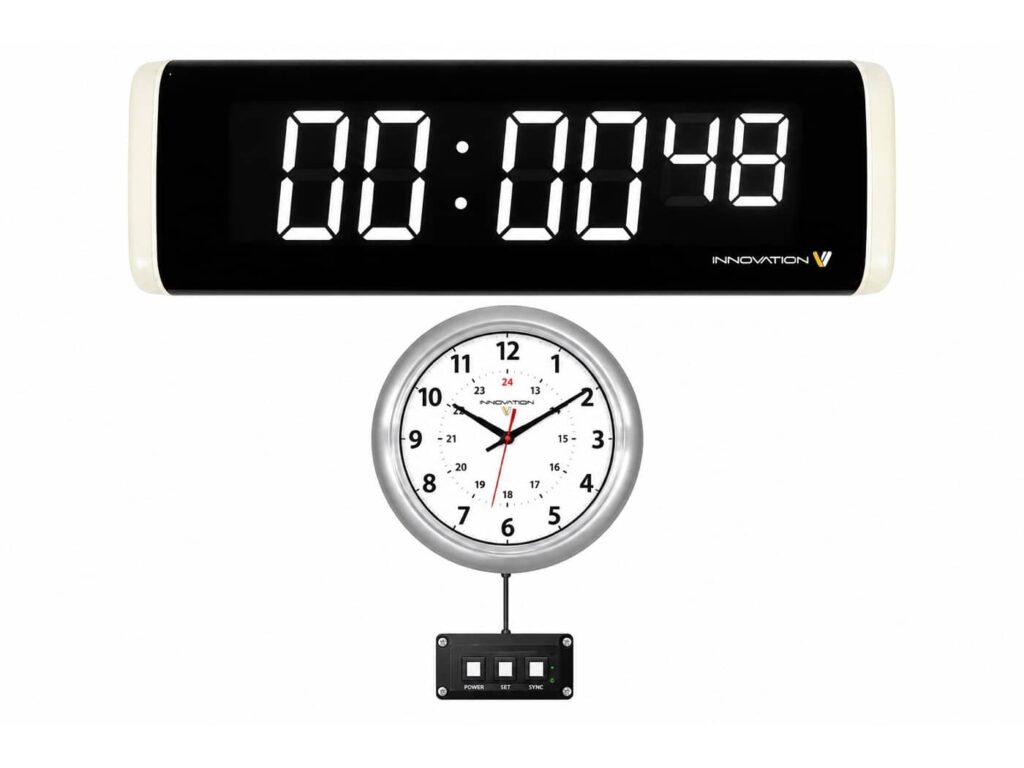
Our countdown timers are used in operating rooms to display normal synchronized time and to run a count in either direction. Tethered to the display is a controller switch with simple buttons, so a surgical nurse starts a count up or a count down with one touch with elapsed procedure time on the same display that shows the time of day between cases, with no separate stopwatch to set, check, or lose. When every second counts, the board everyone trusts is the one already on the wall.
For timing that should start itself on a schedule, the PoE digital countdown timers run from software by time, date, and day of the week, then return to the time of day at zero. One time base runs the surgery suite board, the corridor clock, and the timer which is exactly why the elapsed figure can be trusted in the record afterward, and why teams time cases against it without a second device.
Overhead Paging Systems for Hospitals and the Alerts Nobody Hears Late
Clear audio is the difference between a message sent and a message heard, and overhead paging systems for hospitals have one job above all others: reach everyone, now. Our wireless PA system covers a complete facility without pulling cable, then use our Wi-Fi speakers where the Wi-Fi coverage is strong, IP-PoE speakers where the cabling runs, mixed freely on one signal, in standard and high-powered models with both physical and software volume control. The service module plugs into your Ethernet switch pre-configured, so the paging is working the day it arrives.
Because a corridor is loud and a message can matter, our indoor message boards put the text of an announcement in front of the people who did not hear it. Schedule notices at the elevators, alerts at the nursing units, the written line that reaches eyes as well as ears, from the lobby to the waiting rooms. And for the moments behind the phrase “what is the importance of safety in healthcare,” the same infrastructure carries the silent layer: violence against healthcare workers is the reason staff duress alerting exists, and our wireless panic button systems add a silent press that puts alert messages on the boards and pre-recorded notifications over the speakers. Medical staff and security monitor the same critical information at the same second, through equipment everyone already uses daily.
The Building Layer and the Clinical Layer: An Honest Scoping Guide
Search this category and you will find two different industries using one name, so here is the distinction facility directors and clinical engineering need before writing a spec. The clinical layer is software and licensed device systems: secure clinical messaging platforms, the EHR, hospital wayfinding apps for patients and visitors, patient flow software, healthcare RTLS and hospital asset tracking systems that locate pumps and beds, hospital temperature monitoring for pharmacy and lab refrigeration, and dedicated nurse call. The patient station at the bed, the hospital call light, the call light hospital staff answer and the call bell system for hospital units, the nurse paging system tied into it. Those are real systems with their own vendors, their own standards, and their own budgets.
We do not manufacture a nurse call, and we will tell you that plainly rather than relabel a paging speaker as one. Patient call systems and wireless patient call system offerings are a regulated product class of their own, and the right vendor for them is a dedicated one. What we build is the building layer: the synchronized clocks every department charts against, the OR timers, the overhead paging, the digital signage, and the silent duress switches which is the physical infrastructure the clinical layer sits on top of.
The two layers are complements, not competitors: a clinical messaging app cannot page a corridor or put one time on every wall, and a paging speaker cannot route a patient request to the right phone. Facility leaders who understand this compare each option in its own lane, buy each on its own merits, and stop paying twice where tools overlap in the middle. Whether the location is a regional medical center or a limited-footprint clinic, the same scoping rule holds across medical facilities of every size. If you take one decision from this page, take that one.
Accurate Records, Legal Issues, and the Cost of Ownership
Healthcare administrators live with constant pressure to improve patient care on constrained budgets, so the ownership math matters as much as the features and the benefits have to survive the accounting. Our equipment carries no subscriptions, no maintenance contracts, and free tech support for the life of the equipment. Several leading vendors in this field now route timekeeping through cloud software platforms billed annually; if a competing quote includes that platform fee, ask what happens to the clocks the year the budget cuts it. Then ask us for the cost effective number without one.
The FCC license on the wireless system runs ten years and renews for a nominal fee we paper for you; batteries go five years; electric and PoE models need nothing. One building or a multi-facility organization, the architecture scales by adding transmitters, repeaters, and endpoints, never by adding license seats. Buildings still running legacy wiring convert without tearing out walls: the analog master clock system upgrades to a GPS time base, the dials cut the cord, and the record never notices the transition.
Accurate record keeping is the return in one phrase: consistent, accurate records for logging medications, emergency procedures, and patient files; minimized legal issues and insurance disputes; wall clocks synchronized with your instrumentation; labor hours back. Track it and monitor it however your board prefers after year one it costs nothing to keep, and the accuracy compounds in hospital settings where every entry may be read aloud in a courtroom someday.
Why Hospitals Choose Innovation Wireless
We have engineered synchronized time and communication equipment since 2008, with over 30 years of combined experience on the team, and KRONOsync® is used by many health networks. The healthcare names on our customer list run from Cedars-Sinai and Memorial Sloan-Kettering Cancer Center to Aurora Health Care, ProMedica, Halifax Regional Health System, Central DuPage Hospital, Good Samaritan Hospital, Chester County Hospital, McAllen Medical Center, the USC Keck Health Sciences Center, the University of Colorado Hospital, and the University of Oklahoma Health Sciences Center, twelve institutions that specified carefully and chose ours. Talk to a system specialist at 888-559-5565, tell us what your facility runs today, and we will lay out what to keep, what to replace, and what it costs. Your current setup is always considered in the design.


A sample of the hospitals and health systems on our customer wall — twelve of the 72 organizations are healthcare institutions.