
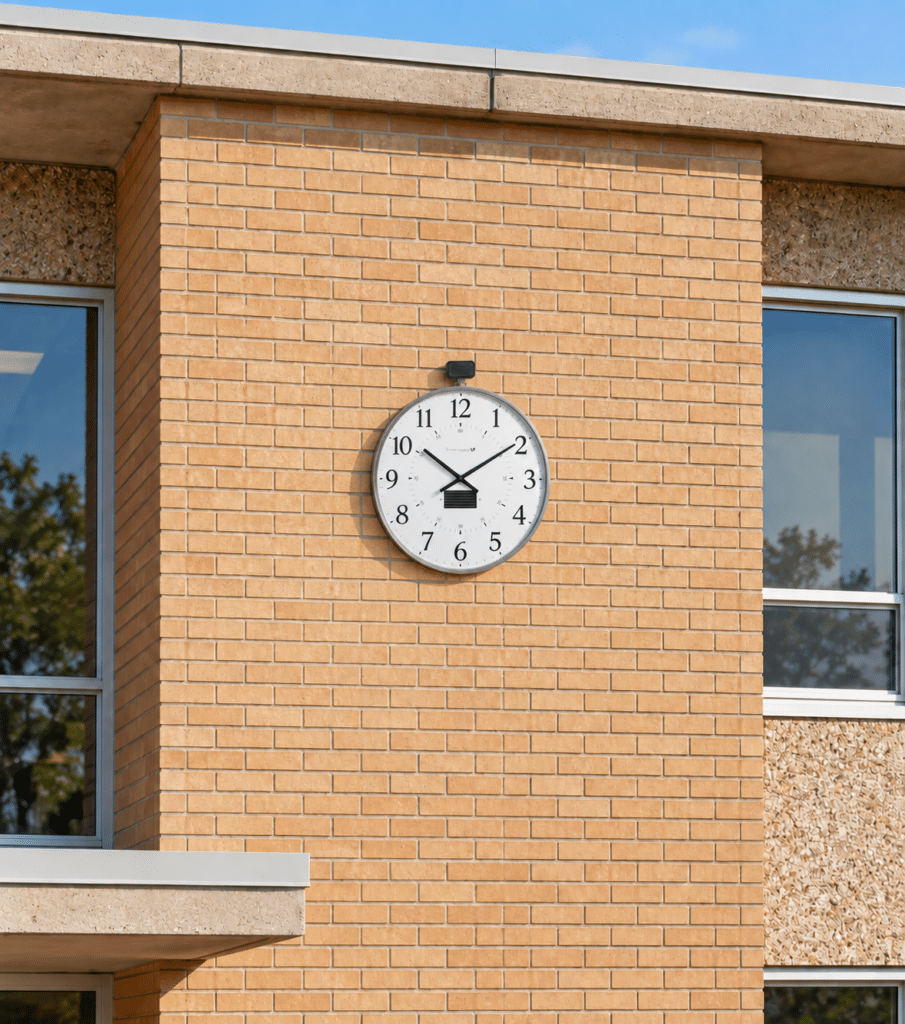
A solar clock from Innovation Wireless gives you exact second time in any and all outdoor applications, with nothing to wire, no AC outlet to install, and no upkeep: a solar panel charges an internal lithium-ion rechargeable battery during the day, that stored solar power keeps the solar clock going for 24-hour use, and a daily update by GPS or by our 467 MHz KRONOsync® transmitter keeps it correct to the second. As of November 2026, our published solar clock product specification lists a 24-inch stainless steel case, a 23.75-inch dial, a glass lens, an IP65 weatherproof rating, and an operating temperature range of 0 to 125 °F; the same weatherproof solar outdoor clock is readable at key locations around schools, courtyards, playgrounds, athletic fields, and golf courses.
In Short
- Solar power only: a solar panel and an internal rechargeable battery store solar power during the day for 24-hour use, so it keeps going through the night and through cloudy or rainy days with no outside power.
- Two sync options: a GPS standalone solar clock that can be used alone without a master clock, or a 467 MHz solar clock that takes its time from the KRONOsync® transmitter already keeping your indoor clocks together. Either way the clock updates itself at 2:00 a.m. every day and changes itself for Daylight Saving.
- 24-inch large display, high-contrast black hands on a white dial, stainless steel and glass, IP65 weatherproof, 14 pounds, bolted to the structure through its stainless backing.
- Free tech support, no maintenance, no subscriptions, and a product data sheet and product specifications you can put straight into a submittal.
Solar Clock Sync Options: GPS Standalone, or the KRONOsync® Transmitter You Already Run
Two receivers are available, and the one you pick depends on how many clocks you need to keep together. The GPS standalone solar clock (product 524008S) stands on its own and can be used alone without a master clock: it uses GPS as its time source to set and keep accurate time, and the GPS antenna is mounted on top for simple setup. Put the solar clock in sunlight, turn the power on, press the set button, and the hands move to 12:00, then set to the correct time when the GPS signal is received. The 467 MHz KRONOsync® solar clock (product 524467S) receives its time from the KRONOsync® transmitter, so it is the right choice for groups that need synced time inside and outside the building, and it works with existing systems that use synced indoor clocks. Every day at 2:00 a.m., either receiver updates the clock to keep it accurate, and during Daylight Saving the solar clock changes itself at 2:00 a.m. Daylight Saving can be turned off in states like Arizona, and the clock works in any U.S. time zone.
What the Outdoor Wall Clock You Have Now Is Costing You
You did not take on the facility to manage the clock on the side of it, yet that is where an ordinary outdoor wall clock leaves you. Outdoor wall clocks can lose time after storms, clock changes, or wear; heat, moisture, humidity, power cuts, and long use can all cause drift or failure, and a cheap outdoor wall clock costs you again every time it is wrong. The battery-powered quartz wall clock is easy to hang and low in price, but it can drift and needs battery swaps, and it is often not made for rough weather. The electric wall clock is dependable until outlets trip, cords fail, or weather and humidity cause issues, and before any of that it needs an electrician, an outlet, conduit, and trenching to reach the wall or post you want it on. The outdoor clock is always wrong. Batteries die quickly outdoors. Nobody wants to run power outside. Everyone ends up checking a phone, and the office that ordered the clock hears about it. Humidity gets into a cheap case, the lens fogs, and the clock face cannot be read at a glance. Outdoors, where activities are often time-based, messy, wet, or split by breaks, a wrong clock does the most damage. The field is ninety seconds behind the indoor clocks. The outdoor reference clock disagrees with the indoor clocks, so the incident timeline has a hole in it. A visibly wrong clock over a courthouse entrance is a small, constant credibility problem.
Why Outdoor Clocks Drift, and What a Synchronized Solar Clock Replaces
The reason is not the clock. It is that an ordinary outdoor wall clock has no time source: nothing tells it the right time after the day it was set, so every storm, every power cut, and every clock change pulls it further from the clocks inside, and everyone stops trusting the wall clock. A synchronized solar clock replaces that whole arrangement with two things the old clock never had: its own solar power, and a daily correction. No cord, no outlet, and 24-hour use means the night is covered. The solar panel turns light into solar power and charges the internal rechargeable battery during daylight, so the solar clock keeps going 24/7, at night and on cloudy or rainy days alike; the solar panel and the rechargeable battery together are the backup for low light and the night. There are no disposable batteries to buy, change, or throw away. The receiver, GPS or 467 MHz, sets the correct time each day, so the clock stays accurate without manual resets, including the Daylight Saving change. The result is a self-sufficient solar wall clock, with no wiring or constant battery changes, that always shows accurate time, placed where it is easiest to see and in view of the people who need it: by the pool equipment area, on a gazebo post, on a post by the first tee, at the bus loop, over the courtyard. No extension cords, no extra drilling, no messy setup.

Power, Design, and Durability of the 24-Inch Solar Outdoor Clock
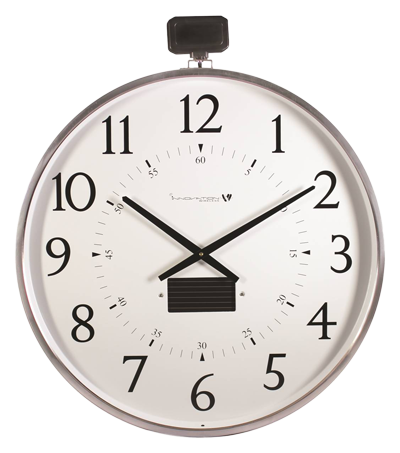
No upkeep: it needs no outside power. Solar powered with an internal rechargeable battery that stores energy during the day for 24-hour use. The 24-inch large display makes it easy to see outside and easy to read from far away, with high-contrast black hands and black numbers on a white dial; measure the actual worst-case viewing point before you commit. The weatherproof design and stainless steel frame add strength and a clean look in any setting: a stainless steel case, a glass lens, and an IP65 weatherproof rating, with a 23.75-inch dial, a 3.1-inch edge, and a weight of 14 pounds. The solar panel sits on the dial at 2 by 4.4 inches; the signal antenna on top measures 2.4 by 3.9 by 1 inch. The operating temperature range is 0 to 125 °F, so outdoor heat and cold are inside the product’s rated range, and the IP65 rating covers the weather. Installation is as plain as the rest of the product: remove the stainless steel backing, bolt it to the outdoor structure, and a thumb screw connects the backing to the clock. Setup after that: place the solar clock in sunlight for a short time, then switch it to ON. It is an analog solar wall clock with a dial and hands, easy to read at a glance.

Where the Solar Clock Goes: Schools, Campuses, Government Facilities, Golf Courses, Pools
If outdoor time has to match indoor time, this is the clock. At a school, the highest-value locations are the ones students and staff look at while a bell is about to ring: athletic fields, tracks, playgrounds, courtyards, bus loops, and pick-up lines, so the field keeps the same schedule as the indoor clocks and a P.E. class is no longer late through no fault of its own. On a college or university campus, quads, stadium and recreation complexes, shuttle stops, and parking structures are where bringing power would be expensive and network coverage is unreliable, and the GPS solar clock needs neither; solar power needs no trench. At a courthouse, a city office, or a civic center entrance, a municipal park, a public works yard, or a transit plaza, an outdoor clock that corrects itself daily is the low-maintenance answer for facilities where nobody wants a work order twice a year for a clock change, and because the solar clock is not drawing from the facility, it keeps working when facility power does not. Golf courses manage tee times from the first tee; aquatic centers manage swim time from the equipment area; barns, workshops, and docks get a solar wall clock where no outlet was ever going to be, and where the price of trenching power would never be approved. Pair it with our indoor Wi-Fi wall clock line or the KRONOsync® system and outdoor and indoor time match across your organization.

Why Buy Your Solar Clock From Innovation Wireless
We are the manufacturer, based in Culver City, California: synchronized clock systems and communication systems since 2008; our customer wall lists 72 organizations, from Yale, MIT, and the University of Texas to Cedars-Sinai, Amazon, Costco, West Point Academy, the Tennessee Valley Authority, and the USPS. Every solar clock comes with free tech support, no maintenance, and no subscriptions. The product is specified like exterior equipment, not decor, with a design you can read in the product specification: IP65 weatherproof, stainless steel, glass lens, solar power stored in a lithium-ion rechargeable battery, a 0 to 125 °F operating temperature, and the product data sheet and product specifications are on this page for your submittal package. With the 467 MHz solar clock, the outdoor clock joins the same KRONOsync® system as our indoor analog wall clocks, so one system and one source of truth cover the whole property, indoors and out. As a school Technology Coordinator wrote in the testimonial on this page: “The good people of Innovation Wireless have been nothing but a godsend to our school.”
Before the Next Clock Change
There is a date when the current arrangement bills you again: the next Daylight Saving change, and the work order twice a year that comes with it, or the hour the outdoor wall clock stays wrong when nobody gets to it. A synchronized solar clock takes that off the calendar: no wiring, no AC outlet, no battery changes, a daily correction at 2:00 a.m., and the clock change handled by the solar clock itself. Tell us where the clock goes, the date you need it by, whether it stands alone or joins indoor clocks you already have, and which U.S. time zone the solar clock will keep, and we will recommend the right receiver and send the product data sheet, the product specification, and the price with the quote. Call 888-559-5565 or request a quick quote, and the next clock change can be the first one nobody has to think about outdoors.
Q&A
What’s the difference between the GPS standalone model and the 467 MHz KRONOsync model?
The GPS standalone model uses its built-in GPS antenna to set and keep accurate time without a master clock — ideal when you only need the outdoor clock(s) to be accurate. The 467 MHz KRONOsync model gets a time code from a KRONOsync transmitter, so it is best for groups that want all indoor and outdoor clocks synced to the same source.
How do I perform the initial setup for the GPS standalone clock?
Put the clock in sunlight, turn the power on, then press the set button. The hands first move to 12:00 and then set to the correct time once a GPS signal is received. After that, it self-updates daily at 2:00 a.m.
Will the clock stay accurate in locations with limited sun or during bad weather?
Yes. The solar panel charges an internal rechargeable battery during daylight, so the clock runs 24/7, including cloudy or rainy days. Time accuracy is kept through the daily GPS or 467 MHz time update at 2:00 a.m.
Can I disable Daylight Saving Time changes for locations like Arizona?
Yes. Daylight Saving Time can be turned off where it is not observed, while the clock keeps getting its daily time update for second-accurate operation.
What environments are these clocks best suited for?
They’re made for outdoor visibility and durability ideal for schools, courtyards, playgrounds, athletic fields, golf courses, pools, patios, workshops, docks, barns, and other areas where clear, synced time helps work flow.