
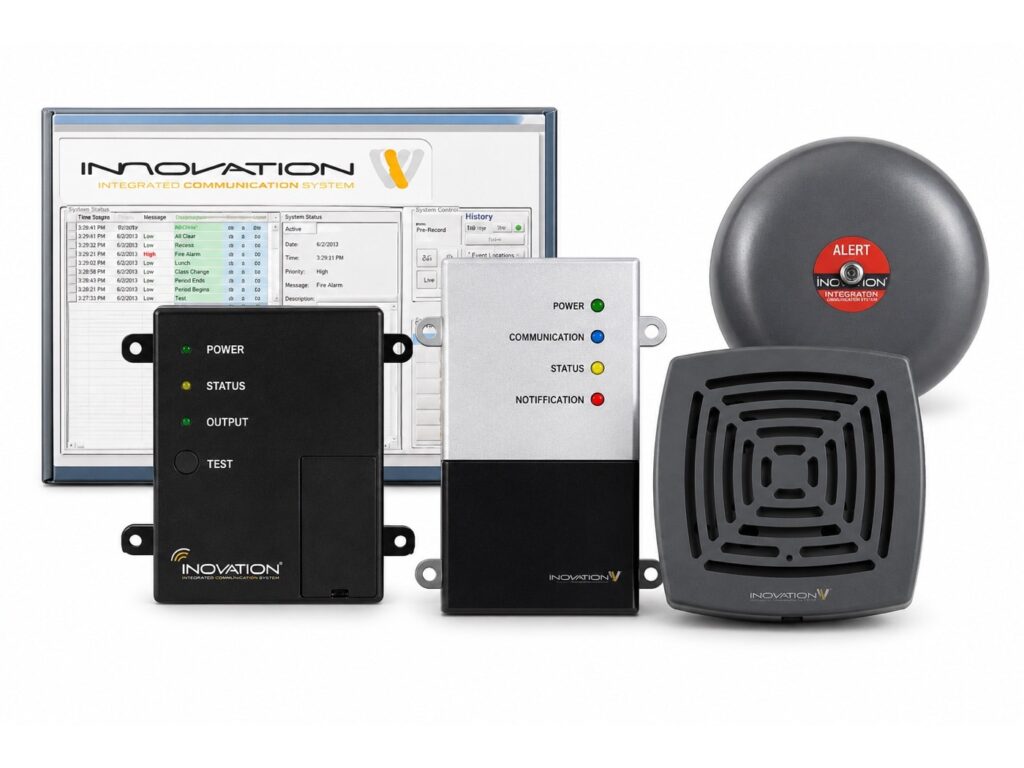
The phrase “industrial communication systems” means two different things, and buyers land on the wrong pages every day because of it. In automation engineering, it means machine-to-machine networking Modbus, fieldbus, and the industrial Ethernet protocols that let controllers, sensors, and actuators exchange data. This page is about the other meaning: the facility-level network of synchronized clocks, shift bells and buzzers, paging speakers, message boards, and countdown displays that runs the people side of a plant or warehouse. We have built these systems since 2008 from Culver City, California. Twelve of the 72 organizations on our customer wall are manufacturers and industrial operators, from 3M and Caterpillar to Siemens and John Deere and the tone generator we ship today carries two normally closed and two normally open contact closures which means it wires straight to the bells and buzzers your building already owns and puts them on an automated schedule. This page explains how the facility layer works, what each part does, and where our equipment ends and plant telephony and machine networking begin.
In Short
- One synchronized network runs the clocks, shift bells and buzzers, paging, digital signage, and break countdowns for an entire plant or warehouse and it can drive the bells you already have through contact closures instead of replacing them.
- Clocks sync to one GPS or NTP time source over 467 MHz wireless, Power over Ethernet, or Wi-Fi, adjust for daylight saving automatically, and need nothing beyond batteries every five years or nothing at all on electric and network-powered models.
- Accurate shift starts, on-time returns from break, and paging that carries over production noise are productivity you can measure and the same network carries emergency alerts to every corner of the floor.
- Every system ships with free tech support, no subscriptions, and no maintenance contracts, and the customer list runs from 3M and Caterpillar to Lockheed Martin and the Tennessee Valley Authority.
The Warehouse Clock System That Ends “Late From Break”
A plant runs on minutes the way it runs on material, and the warehouse clock system is where the minutes get honest. The foundation every shift stands on, and the evolution from wired clocks drifting alone to one master time source. When every clock on the floor, in the break room, and at the time clock by the door reads the same second, arrival and departure times are accurate, employees return from break on the clock’s word, machine operators hear the same bell as the dock, and hard-wired excuses like “the clock over the line is slow” disappear, the live math behind greater operational productivity and shift efficiency. The punch clock and the wall clocks agree, so time tracking disputes end where they start. Our clocks hold reliable communication with the transmitter around the clock, producing accurate synchronized time across the whole building and front office included with reliability you never think about and no clock maintenance to speak of: batteries every five years on battery models, nothing on electric and network-powered ones, and daylight saving handled automatically every spring and fall. Warehouse clocks and factory clock installations are not decoration; they are the cheapest supervision a facility ever buys, because the schedule enforces itself.
Shift Bells and Buzzers on a Schedule That Runs Itself
The bell layer is where accurate time becomes an orderly shift and where our approach saves real money, because you keep the bells you own. Our tone generator wires your existing bells and buzzers to its two normally closed and two normally open contact closures, then switches them on the schedule you set, integration happens at the contact closures, the setup is simple, and you create the schedule once, down to the length of each break. The network bell system version is an IP-PoE device powered by standard AC or Power over Ethernet, controlled by bell software on an administrator’s computer, with multiple schedules ready for regular weeks, short shifts, and shutdown days. The wireless bell system version works with our KRONOsync® wireless clock transmitter: it receives accurate time over the air, and your buzzer schedule rides an SD card we supply with the scheduling software, then load the schedule, insert the card, done. Either way, shift starts, breaks, and line changes ring themselves all year, and nobody stands by a switch.
Paging, Signage, and Counts Over the Plant Floor
Production floors are loud, which is why our speakers come in standard and high-powered models with both physical and software volume control for coverage matched to the space, from a small shop to a full warehouse, with high-powered models optional where noise wins. The wireless PA speakers install without pulling cable, Wi-Fi and IP-PoE models mix freely on one signal, and the service module arrives pre-configured for your network, working the day you plug it in. Because a message can matter more than the noise around it, indoor message boards put the text of an announcement in front of the people who did not hear it and shift assignments and notices at the entrance, line status over the floor, the written line that reaches eyes as well as ears. The combination of speakers and boards is what makes a loud building reachable. And for the counts a schedule should own, PoE digital countdown timers run software-scheduled counts by time, date, and day of the week, when the break begins, every display counts it down, progress visible to the second and at zero the displays return to synchronized time, so everyone returns to the line together.
Warehouse Safety, Answered by Infrastructure
Most warehouse safety topics such as forklift traffic, lockout discipline, evacuation drills, incident monitoring and response come down to one operational question of the utmost importance: do you have the ability to reach everyone, now? The same infrastructure that rings the shift carries the safety layer. Announcements broadcast to the whole building or one zone; boards put the alert in writing; and our wireless panic button systems add a silent press that puts alert messages on the boards and pre-recorded notifications over the speakers, so the people responsible for the floor, the office, and security see the same critical information at the same second. Warehouse safety is trained in meetings, but it is delivered by infrastructure through equipment everyone already uses every day, which is exactly why it works under stress.
Industrial Ethernet Protocols vs. the Facility Layer: An Honest Scoping Guide
Because the term is shared, here is the scoping distinction plant engineers and facility managers need before writing a spec. The machine layer is characterized by data exchange between equipment: Modbus (introduced in 1979, still supporting up to 247 devices on one network), PROFIBUS (developed in Germany in 1989), OPC UA (1994), and the industrial Ethernet families “Ethernet/IP, PROFINET, and EtherCAT” engineered for determinism and reliability over raw throughput. That world, one of the two categories of vendors sharing this term has its own hardware, its own standards bodies, and its own budget line, and nothing on this page belongs to it; we build the people side, not protocol stacks. Plant telephony is likewise its own product class: an industrial telephone or industrial phone for the floor, the explosion proof telephone rated for hazardous-location applications, the rugged IP phone, phone enclosures that shield a handset from dust and washdown, and the cleanroom telephone built for controlled environments. We do not manufacture telephones or enclosures, and we will tell you that plainly rather than relabel a paging speaker as one, the right vendor for hazardous-location telephony is a telephony vendor.
What we build is the facility layer people run on: the synchronized clocks the shift charts against, the bells and buzzers on schedule, the paging and signage that reach the whole floor, the counts, and the silent alerts. The layers are complements, not competitors, a fieldbus cannot ring a break, and a paging speaker cannot commission a PLC. Buy each layer in its own lane, on its own merits, and stop paying twice where vendors blur the middle. If you take one scoping decision from this page, take that one.
Keep Your Bells: Low Cost of Ownership
Industrial budgets across heavy industry reward equipment designed to work with what you already own, and that is the design principle here: a business case your controller can sign, with advantages that compound and operational efficiency that shows up in the schedule, not a slide deck. The contact closures drive your existing wired bells and buzzers, so automation does not mean replacement. The equipment carries no subscriptions, no cloud dashboards, no accounts to manage, no per-seat prices, and no training requirement, free tech support for the life of the equipment, and it will save maintenance resources from year one; the FCC license on the 467 MHz wireless system protects it from interference, runs ten years, and renews for a nominal fee we paper for you. Batteries go five years; electric and network models need nothing. One building or a multi-plant operation, the architecture scales by adding transmitters, repeaters, and endpoints, never license seats. Accurate shift timing is essential to an efficient, orderly changeover, and the return is plain: on-time breaks, paging that carries, alerts that reach everyone after year one it costs nothing to keep.
Why Manufacturers Choose Innovation Wireless
Our company has engineered synchronized time and communication equipment since 2008, with over 30 years of combined experience among the team members. The industrial names on our customer list run from 3M, General Electric, and Caterpillar to John Deere, Siemens, Lockheed Martin, Southern Nuclear, and the Tennessee Valley Authority, industrial clients that specified carefully and chose ours. As one customer put it: “Innovation Wireless is a dependable manufacturer who provides a quality, reliable product for Synchronized Time and Communications, along with helpful staff who are readily available when you need them”. Norman Aycardo, World Bridge Tech. Talk to a system specialist at 888-559-5565, tell us what your facility runs today, and we will lay out what to keep, what to replace, and what it costs. Your current system “bells included” is always considered in the design.


A sample of the manufacturers and industrial operators on our customer wall — twelve of the 72 organizations are industrial names.