
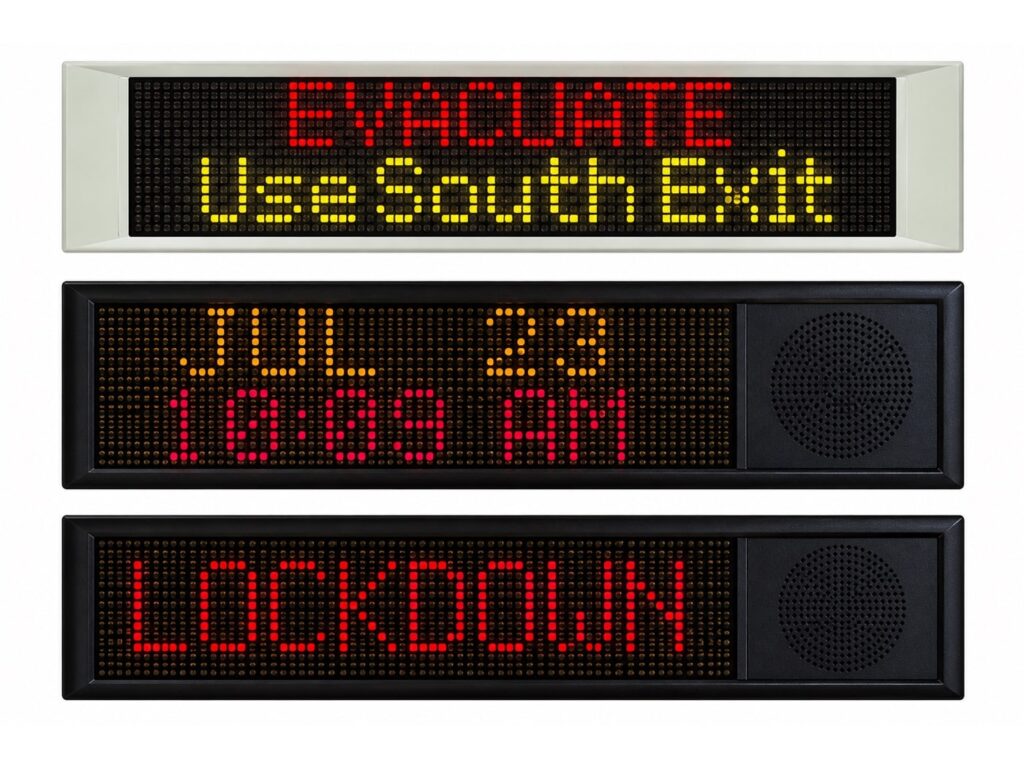
Government facility communication systems are the synchronized clocks, paging speakers, message boards, and silent alert switches that keep a courthouse, public office, depot, or emergency operations center running on one verifiable time. In public work, time is not a convenience, it is the baseline every record, docket, dispatch log, and meeting minute is predicated upon, and a room full of disagreeing clocks puts a question mark on all of them.
We have designed and deployed these systems since 2008 from Culver City, California. Ten of the 72 organizations on our customer wall are government, defense, or public-authority names, from USPS and the Tennessee Valley Authority to the Federal Executive Institute (verified September 2026).
The KRONOsync® transmitter sends an FCC-licensed broadcast through the premises with no programming required: apply power, place the clocks anywhere, and every display updates daily, 365 days a year.
This page is an overview of how the solution works for public buyers at every level, and where our equipment ends and mass alerting, radio, and door control begin.
What a Government Facility Communication System Does
- One synchronized signal runs the clocks, paging, digital signage, and silent alerts for government facilities and scales across every location an agency operates, so the same second holds department-wide.
- The wireless system needs no programming and no network connection to keep time: power the transmitter, hang the clocks, and the FCC-licensed broadcast updates every display daily, with daylight saving handled automatically and no timestamp errors between rooms.
- Clocks coordinate with computer time, so the wall, the terminal, and the record agree on punctuality you can verify, data you can defend, and accuracy an auditor can check.
- Everything ships with free tech support, no subscriptions, and no maintenance contracts, and the public-sector customer wall runs from USPS and the Tennessee Valley Authority to a courthouse and a state emergency management center.
The Government Clock System Behind a Defensible Record
The baseline measurement of any operation’s effectiveness, public or commercial, is timed meetings, the coordination of the day’s work, and the evaluation of tasks are all predicated on it.
In the public sector the stakes are sharper, because the clock feeds the record: the time stamped on a filing, logged at a counter, entered in minutes, or noted at intake has to hold up when someone questions it later.
A government clock system closes that exposure at the source. Every dial on the premises reads the same second, coordinates with computer time, and updates itself daily, so the wall and the terminal never testify against each other. Employee punctuality becomes verifiable instead of arguable, productivity rises with reliable time, monitoring schedule compliance stops being a dispute, and repair costs on timekeeping fall to zero. Synchronized clocks for government service are the cheapest audit protection public money ever buys, and the reliability compounds year over year.
Agencies that present records to courts or oversight bodies get that same reliability from the same wall dial. In courthouses the identical architecture answers a narrower name: a courthouse clock system that keeps the bench, the clerk’s office, and the docket board on one legally defensible second.
One Verifiable Time Source, Zero IT Burden
The virtue of this solution for public buyers is how little it asks. There is no programming: apply power to the KRONOsync® wireless clock transmitter and place clocks anywhere on the premises.
The transmitter sends an FCC-licensed broadcast throughout the premises, the license protects the signal from interference and every unit picks it up and displays the time, updated every day of the year. The time itself traces to GPS satellites or your network’s NTP source, the same architecture as our GPS master clock systems, which is what makes the timestamp defensible: it chains to a reference nobody in the room controls.
Because the wireless models never touch your IT, they suit secure facilities and restricted environments where handing network access to a wall clock is a non-starter and sensitive information stays inside its perimeter.
The selection covers analog, LCD digital, and LED digital clocks in battery and electric versions, designed so the courtrooms, the counter, and the garage each get the right face on the same second with the durability to run for years between battery changes.
Deployment brings no configuration challenges to schedule around and nothing for the help desk to maintain. The result is accuracy on every wall, accuracy that holds itself with no hand-setting. Where wiring is preferred, PoE and Wi-Fi models pull the identical time over your own infrastructure instead.
Paging and Signage for the Public and the Staff
A government building talks to two audiences at once, the public in the lobby and the personnel behind the counter and the same signal serves both.
Our wireless PA system installs without pulling cable through a secured building: Wi-Fi and IP-PoE speakers mix on one system, standard and high-powered models match the space, and the service module arrives pre-configured. Announcements reach one zone, one floor, or the whole premises, and integration with the time layer means the message and the timestamp always agree.
Indoor message boards put the message in writing, docket calls and window changes in the lobby, operational notices in the work areas, and, when it matters, emergency instructions in every corridor at the same moment the speakers carry them.
The same broadcast reaches operations centers, where what is posted must match the log to the second. Spoken and written together is how a message reaches everyone, including visitors who have never set foot inside before.
Silent Alerts Before Help Arrives
Public-facing counters carry real risk, and the people behind them deserve a way to summon help without escalating the moment. Our wireless panic button systems add a silent press at the clerk’s window, the bench, the intake desk that puts alert messages on the boards and pre-recorded notifications over the speakers, so guards and staff across the premises see the same critical information at the same second, through equipment everyone already uses daily.
One action, every corridor, spoken and written at once, whether the trigger is a counter incident, an evacuation, or a shelter order. The same reach supports emergency preparedness plans directly, drills run over the real equipment, training happens on the gear staff use every day, and incident response starts with everyone hearing the same instruction before first responders arrive.
Police and outside help are notified by your own procedures; our job is to create order inside the walls in the minutes before they get there. That is emergency communication done at the source.
Most alerting products sold to the public sector today are software subscriptions; this one is hardware you own outright.
Public Safety Alerting, Radios, and the Building Layer
Here is the honest scoping guide for a public-sector spec, because vendors blur these categories and buyers pay twice for the overlap. Mass alerting platforms, the software that pushes warnings to residents’ phones and broadcast media across a jurisdiction or region — are their own regulated world, and we do not sell them. FEMA’s Integrated Public Alert and Warning System (IPAWS) is the federal backbone that pushes those warnings through multiple channels at once, and carrier programs like Wireless Priority Service keep official calls moving when circuits jam; specified through emergency-management channels, not through us.
Land-mobile radio, the interoperable handheld and vehicle fleets that dispatch runs on, with the resource sharing agreements that let neighboring government agencies and mutual-aid partners talk to each other is likewise its own product class with its own vendors and licensed spectrum; interoperability between radio fleets is addressed by those vendors and by state grant programs. CISA’s shared-infrastructure guidance encourages neighboring jurisdictions to pool radio and alerting capacity not by wall dials.
Door control, cameras, and screening belong to the security integrators. We will say plainly that none of that is ours. What we build is the layer all of those assume: the synchronized clocks every log entry depends on, the paging and signage that move people inside government buildings, and the silent alert switches at the counters.
A resident-alert platform cannot fill a courthouse corridor with instructions, and a paging speaker cannot notify a city. The layers are complements that assess each in its own lane, determine what your plans actually require at the building level, and stop paying twice where the middle blurs.
The same logic holds across environments: an office of records, a motor pool, even correctional facilities, all with different settings, same layer underneath.
Shrinking Budgets, Standing Equipment
Government workers face continually increased responsibilities against constantly shrinking budgets, which makes the ownership math a compliance question of its own. The benefits are simple to list: no subscriptions, no maintenance contracts, and free tech support for the life of the equipment. Nothing that dies in a future budget cycle, nothing recurring to justify to a board, no cloud dependency that turns timekeeping into an outage and battery models ride out power failures, so the record keeps its time even when the building loses everything else.
The FCC license runs ten years and renews for a nominal fee we paper for you; batteries go five years; electric and PoE models need nothing. Where other capital projects compete for the same dollars, this one is implemented in a day and maintained by nobody.
One building or every location a government agency operates, the architecture scales by adding transmitters, repeaters, and endpoints “never license seats”, so teams and larger operations grow the same installation instead of buying a new one. Grant-funded projects often bundle timekeeping upgrades into larger renovations; ours slots into either, or stands alone as the smallest line item that benefits everyone under the roof.
Call for a quote and we will price the system to your spec: what to keep, what to replace, and what it costs, in writing.
Why Government Agencies Choose Innovation Wireless
We have engineered synchronized time and messaging equipment since 2008, with over 30 years of combined experience on the team, and public-sector work is a large part of why the company exists.
The names on our customer list speak the language of this page: USPS, the Tennessee Valley Authority, West Point Academy, the Federal Executive Institute, the Midland County Courthouse, the Nebraska Emergency Management Center, the Transit Authority of Northern Kentucky, and the Palo Verde Nuclear Plant, alongside defense names like Lockheed Martin and Orbital ATK.
Buyers who answer to auditors, inspectors, and the public assessed their options carefully and chose ours; several of those environments are among the most restricted in the country.
Talk to a system specialist at 888-559-5565, tell us what your building runs today, and we will draft the design and lay it out plainly. That support does not expire, and it does not depend on a reseller. Your current setup is absolutely always considered, with the point is to make the most of what you already maintain.


A sample of the government, defense, and public-authority names on the Innovation Wireless customer wall.
Get a Straight Answer on Your Building’s System
Tell us your location count, your public-facing areas, and what runs your clocks and announcements today. A specialist will lay out exactly what the synchronized layer looks like for your team; clocks, paging, signage, and silent alerts on one signal: what to keep, what to replace, and what it costs, in writing.
Call 888-559-5565 or request a quick quote, and get a solution built around your premises, your budget, and what your team already supports.